When someone decides to bring a cat home, they almost inevitably imagine the future.
She arrives. Looks around. Eats. Within a couple of days she is already lying beside you on the sofa, coming over for a stroke, playing and meeting you at the door. Perhaps she will be a little worried during the first day — it is a new home, after all — but then everything will become what we imagined.
Sometimes that is exactly what happens.
And sometimes a cat arrives and disappears under the bed.
A day passes. Three days. A week. She hardly appears while people are around. At night, however, she comes out, eats, uses the litter tray and explores the flat. At the first signs of human activity, she hides again.
And this is where perhaps the hardest part of adaptation begins. Not only for the cat.
For the person too.
Because we are already ready to love her. We bought the bowls, chose a bed, made room beside us. But the cat is not yet remotely ready to return those feelings.
And the first thought can very easily shift from “she just needs a little time” to “what if she is unhappy here?”
Then another thought may follow: perhaps she would be better off going back?
A WEEK IS VERY LITTLE TIME
I started thinking about this now because of an adult cat from my cattery.
Before moving, she was sociable, affectionate and entirely comfortable living around people. But several major changes have happened in her life over a relatively short period. In yet another new home, she hid.
For the first week she hardly came out to people at all.
At night, however, she comes out by herself, eats, uses the litter tray and explores the space. In other words, she has not stopped living. She has simply chosen, for now, the way of getting to know this new world that feels safest to her.
Her new owners are treating her gently. They worry about her and are trying not to put pressure on her. Their anxiety is completely understandable. When you bring an animal home, you want to see that she is all right.
But after a week the question already arose: if nothing changes, might she be better off returning to her previous home?
And I caught myself thinking that there is a much broader question here.
What exactly are we taking on when we say, “We are taking this cat”?
THE CAT DOES NOT KNOW THAT YOU CHOSE HER
For a person, an animal’s move usually begins long before the actual journey.
We look at photographs. Talk to the breeder. Discuss temperament. Imagine the cat in our home. Buy everything she will need. Wait for her.
We have a whole story in which the arrival of a new pet is a long-awaited event.
The cat has none of that story.
For her, one day the entire familiar world simply disappears.
Familiar people. Other animals. The smell of home. Sounds. The places where she is used to sleeping. The routes she walks every day. Even the position of her food bowl and litter tray.
In their place come an unfamiliar flat, strange smells, different sounds and people she does not yet know.
We look at her and think, “But here we are. We love you. What are you afraid of?”
She has no idea yet who this “we” is.
She still has to find out.
SOMETIMES IT TAKES A VERY LONG TIME
One story that stays in my mind is not about an adult cat at all, but a small kitten from another cattery.
He arrived with his new family already extremely anxious. He hid, was frightened of people and panicked. And it did not last for a week, or even for a month.
It lasted for around six months.
Against the background of stress, he developed intestinal problems and a coronavirus infection became apparent. The kitten soiled the sofas. His owners treated him, wrote to the breeder, worried and dealt with the consequences.
It was nothing like the picture a person imagines when they bring a kitten home.
But among all those problems there was one thing that did not appear: the idea that he should be returned simply because he was not what they had expected him to be straight away.
Today he is a completely affectionate, people-oriented house cat.
Can we conclude from this story that you simply have to wait six months and every frightened cat will inevitably become the same?
Of course not.
But we can draw a different conclusion: what we see during a period of severe stress is not necessarily the animal with whom we will live for the next ten or fifteen years.
SILVER, WHO CAME OUT AT NIGHT
There was also Silver in my life — an adult male from another cattery.
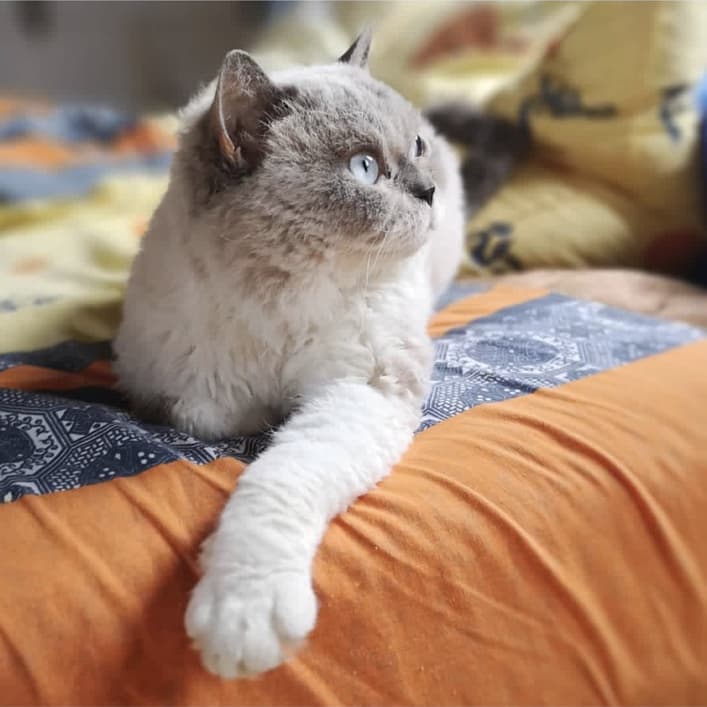
When he came to us, he was rather timid too. At first he hid under the sofa.
Then, gradually, he began to trust my mother-in-law. After that he became used to the rest of the family. Life settled down, and humans once again became something normal and safe to him.
Later, Silver moved again.
Part of the story repeated itself.
In his new home, at first he again preferred to come out at night. His owner later told me a funny story: one night she opened her eyes and was actually startled — Silver was simply sitting beside her, silently watching her.
I love that story.
Because if you look at it from the cat’s point of view, there is nothing particularly strange about it.
During the day the new human is a little frightening. At night, at last, she lies still, does not walk around the flat and does not try to interact. You can come out. Walk closer. Look. Sniff. Study this mysterious new neighbour on safe terms.
Silver got to know the person when he himself was ready.
Eventually everything became normal in that home too.
He simply needed time.
“OUR CAT HAS A PROBLEM” AND “THE CAT IS THE PROBLEM”
I think there is an enormous difference between those two ideas.
“Our cat has a problem. How can we help her?”
And:
“The cat is causing a problem. Perhaps we should return her?”
The external circumstances may be exactly the same.
The cat hides. Does not come over. Is frightened. Does not want to be held. Only comes out at night.
But in the first case, the person has already mentally placed themselves and the animal on the same side of the problem.
In the second, the cat herself gradually becomes the problem.
This is not to say that a good owner must heroically endure absolutely everything and never ask questions.
Quite the opposite.
If something worries you, write to the breeder. If symptoms appear that may indicate a health problem, speak to a veterinary professional. If you do not understand the animal’s behaviour, ask. Sometimes the situation genuinely needs to be changed rather than simply waited out.
Some homes do not suit a particular cat. There can be incompatibility with other animals. There can be health problems. There can be serious behavioural difficulties.
And sometimes returning the cat really is the right decision.
But the first week after a move tells us very little about what this cat will be like with these people in a month. Still less about what she will be like in six months.
AN ADULT CAT ARRIVES WITH HER HISTORY
Psychologically, people sometimes find it easier with a kitten.
We already accept that a kitten is small, has things still to learn, may make mistakes, may be frightened and may need time to settle.
For some reason, it is very easy to expect a finished result from an adult cat.
If she was affectionate and sociable with the breeder, then surely she should arrive at my home exactly the same.
But an adult cat arrives not only with her temperament. She arrives with her life experience.
After the move we may see a completely different version of her.
A sociable cat may hide.
A confident cat may become cautious.
A cat who lay calmly in my arms may, at first, refuse to let a new person come anywhere near her.
That does not mean the breeder described her temperament incorrectly.
And it does not necessarily mean the new family is doing something wrong.
Sometimes what we are seeing is simply a cat under stress.
We may only begin to meet her real temperament after that stress starts to fade.
SO NOW I AM GOING TO ASK ONE QUESTION
This story has made me change my own approach to placing adult animals a little.
Previously, I told a future owner about the cat’s temperament, habits, health, grooming needs and relationships with other animals.
Now I will add one more question.
A very direct one.
“Imagine that for the first month this cat lives under the bed, comes out only at night and will not let you stroke her. Do you still want to take this particular cat, and are you prepared to wait calmly?”
Not because I expect that exact scenario.
It is perfectly possible that the cat will step out of the carrier, inspect the flat within an hour, come to sleep in the bed that evening — and the whole “adaptation” will be over almost before it has begun.
But I want to understand something else.
Is the person choosing only the cat they saw in photographs and heard me describe?
Or are they prepared to accept her possible stressed version as well?
The version who, for a while, gives them nothing in return.
WHAT “WE ARE TAKING THIS CAT” REALLY MEANS
For me, this is probably where the line lies.
An animal is not obliged to fulfil our expectations of her arrival immediately.
She does not know how long we spent choosing her photograph. She does not know which bed we prepared. She does not know how we imagined our first evening together.
And she is not required, on the very first day, to play the role we have already written for her in our heads.
When we take an animal home, we are not accepting a promise about what she will be like beside us.
We are accepting the responsibility to give her enough time to become herself beside us.
Sometimes a few days really are enough.
And sometimes, at first, you simply have to get used to the fact that there is a cat living under your bed.