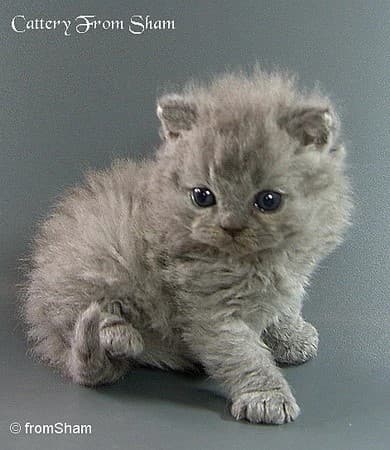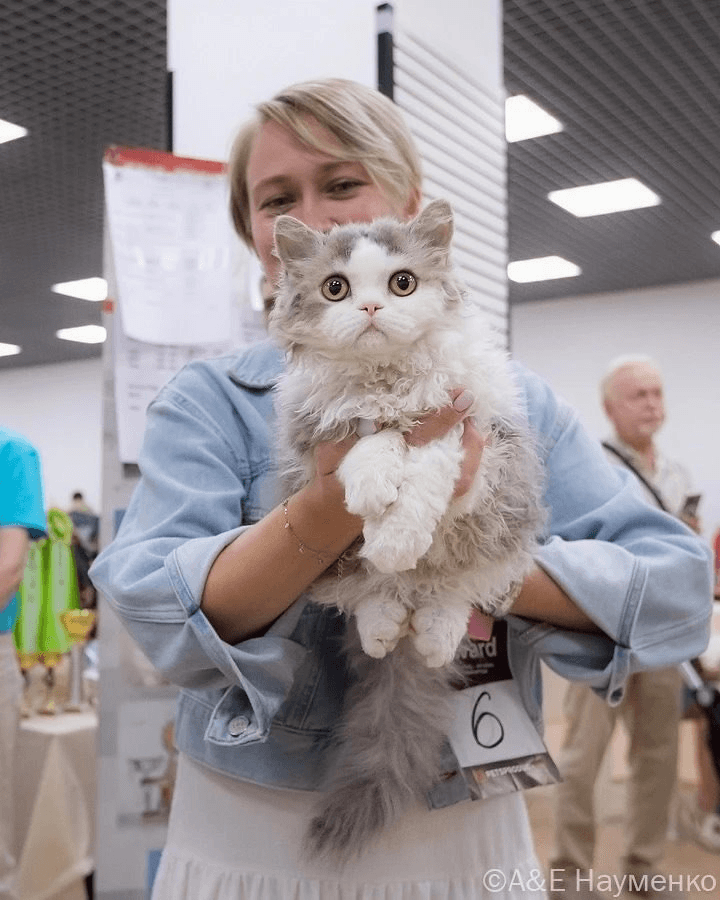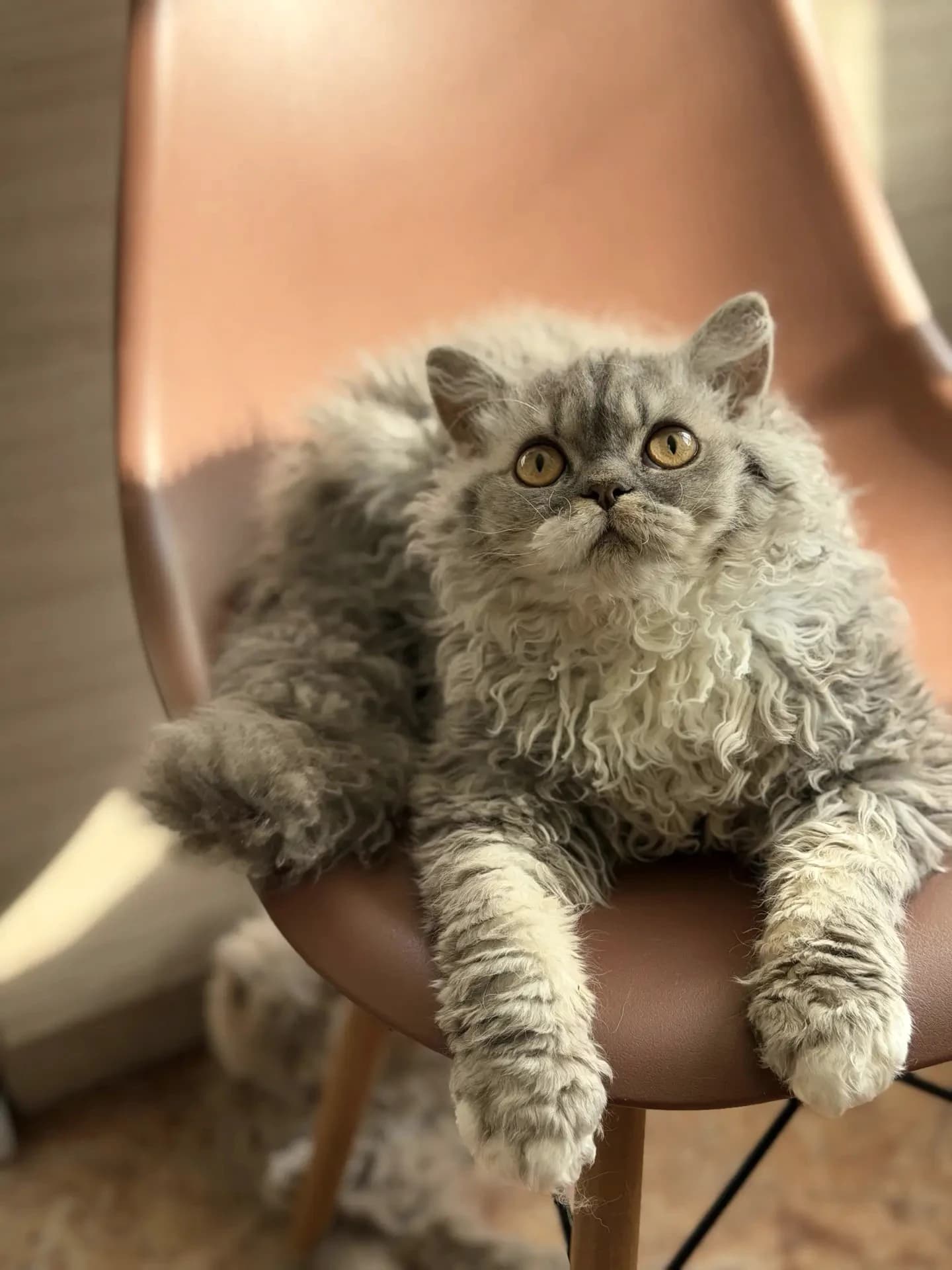
It is very easy to fall into a trap with a curly coat: it seems that the more thoroughly a cat is combed, dried, fluffed and generally tidied, the more beautiful it should become. With Selkirks, the opposite is sometimes true. The more diligently an owner cares for the curls, the fewer curls may remain in the end.
The first rule I have reached over my years with the breed is that a Selkirk should not be combed excessively. Loose Selkirk hair often remains gathered within the curl itself, so what comes away in the comb is not a few separate hairs but an almost complete curl. If you comb a cat constantly and vigorously, you can rather quickly remove a considerable part of its beautiful coat with your own hands.
That does not mean a Selkirk never needs a comb. On the contrary, I always comb the cat thoroughly before washing. I like a comb with long, fine teeth for this: it is easy to work through the coat down to the roots and check whether any mats have formed. If there are any, they need to be teased apart before the bath; a specialist detangling spray can be used if necessary. Washing an already matted coat is a bad idea. Water can turn a small knot into a real felt pad that is much harder and more unpleasant to remove later.
After washing, a completely different story begins. The usual grooming sequence — wash, blow-dry, comb — does not suit a Selkirk. If you direct a strong stream of air at the curly coat and start straightening it, it is very easy to produce a dandelion. The curls separate into individual hairs, the coat becomes fluffy and the characteristic Selkirk structure disappears.
Professional groomers have their own techniques and equipment, including drying cabinets with a gentle airflow. At home, however, I prefer a much simpler approach. After washing, I blot the cat thoroughly with a microfibre towel and sometimes wrap it briefly so that the fabric absorbs most of the moisture. Then I let the coat finish drying naturally in a warm room.
I do not comb a Selkirk’s damp coat. It must dry completely. Afterwards, if necessary, you can use a texturising product and work the coat gently with your hands to give the curls greater definition. The analogy with human curly hair works very well here: if it is continually stretched, brushed and fluffed, the curls become less visible.
THE ‘COLLAPSED COAT’ EFFECT
After washing, there can be an effect that I call the coat ‘collapsing’. The curl itself may even look better and more expressive than it did before the bath. It is the volume that disappears: the coat lies closer to the body, making the cat look slightly flatter.
The volume usually returns after two or three days, while the curls remain, and the coat acquires that beautiful finished appearance.
For that reason, I never judge the result of washing a Selkirk on the first day. If a photo session is planned, it is better to wash the cat several days beforehand rather than the day before.
I do exactly the same before shows. If a show is at the weekend, I am more likely to wash the cat on Wednesday than on Friday. I do not use a hairdryer. During the remaining days, the coat regains its volume naturally, and I may occasionally emphasise the curls a little with texturising product and my hands.
HOW OFTEN TO WASH A SELKIRK
If you want a Selkirk to look good and remain genuinely curly, it needs regular washing. Not every few days, of course, but roughly once a month is a perfectly good guide.
Washing cleans the coat, allows the curls to gather again and makes them more defined. The coat initially ‘collapses’ temporarily, and its volume returns two or three days later.
Over the years with Selkirks, I have noticed a fairly simple pattern:
dry coat — less curl;
dirty coat — less curl;
too long since the last wash — less curl;
stress — less curl too.
A curly coat has proved to be far more changeable than beautiful photographs might suggest.
EVEN THE AIR MATTERS
Humidity demonstrates this very clearly. In a room where the air is too dry, the same cat may look noticeably less curly. In more humid air, the curl is easier to see.
In winter, when the heating is on and the air in a flat becomes very dry, a Selkirk may therefore temporarily lose some of its usual curl. Nothing has happened to the cat itself; its coat simply looks different in those conditions.
MOULTING: A LOT OF COAT ON THE CAT DOES NOT NECESSARILY MEAN A LOT OF HAIR IN THE HOME
Some Selkirks moult very heavily, far more heavily than one would normally expect of a domestic cat. Even so, I would not say that a curly Selkirk necessarily leaves an enormous amount of hair throughout the home.
Loose hairs often remain gathered in the curls rather than drifting around the flat one by one. A cat may lose a very noticeable volume of coat without its owner having to remove individual hairs from every item of clothing and piece of furniture each day.
It is particularly easy to overdo the combing during a heavy moult. A person sees how much hair is coming away, begins combing even more actively and removes a considerable part of the cat’s coat in just a few sessions. It is important to remember that an entire formed curl may come away at once.
WHAT ABOUT HOMOZYGOTES?
One might imagine that a homozygous Selkirk has it easier: homozygotes often do have very dense, tightly curled coats.
Yet matters are not so simple here either. They can shed their coats very severely, sometimes leaving areas almost entirely bare. The coat then grows back and the pronounced curl returns.
Even a homozygote is therefore not obliged to look equally luxuriantly coated throughout its life.
HORMONES CHANGE THE COAT TOO
A female cat’s reproductive life has a very noticeable effect on her coat. Here I mean queens specifically, not males.
I have repeatedly observed an interesting pattern in my breeding queens. After the first litter, the coat may still recover fully; during the next pregnancy, the queen may even look magnificent, with a rich coat, good volume and beautiful curl.
With each subsequent litter, however, the picture gradually changes. In my observation, the longer the queen’s reproductive life continues, the weaker the curl becomes. The same cat may look entirely different after her first and fourth litters. Sometimes the coat becomes so straight that the queen almost resembles a straight visually, although genetically, of course, she has not become one.
After the end of her breeding career and neutering, some of the curl may return. The former coat does not always recover, however, and usually not to the volume the cat had when she was young.
A photograph of an adult breeding queen therefore does not necessarily show how curly she was several years earlier.
A BEAUTIFUL COAT DOES NOT BEGIN WITH A COMB
There is one more thing on which I certainly would not economise if I wanted a Selkirk to look beautiful: nutrition.
The quality of the diet very quickly affects the condition of the coat. When the coat is dry, dull and lifeless, it is difficult to expect a good curl. If you want your Selkirk to look good, do not economise on food.
Among supplements, I like salmon oil. In my observation, it makes the coat softer and silkier, and it feels less dry. It should of course be given in a sensible quantity: it is a useful addition to the diet, not a case in which pouring in more will make the cat more beautiful.
Not every deterioration of the coat should be attributed to the breed’s characteristics. If it suddenly begins to fall out in a completely unusual way, pronounced bald patches appear, the skin changes, itching develops or there are other symptoms, the cause needs to be investigated separately.
WHAT, THEN, DOES A GOOD CURL NEED?
Very little, in fact: a clean, healthy coat, good nutrition, sufficient humidity and minimal rough interference with the curl’s natural structure.
A Selkirk coat appreciates care, but thoroughly dislikes constant attempts to ‘improve’ it. Wash the cat at the right time, comb it gently before bathing, let the coat dry in peace, monitor its condition — and sometimes simply leave the curls alone.
With a Selkirk, excessive diligence can very easily produce precisely the opposite of the desired result.