People regularly ask me, ‘What does homozygous mean?’, ‘Why does this Selkirk look completely different from that one?’ or ‘Is a Straight really a Selkirk at all?’
I understand the confusion. Two curly Selkirks can look so different that it is hard to believe the difference is not only a matter of lines and individual type. Even for one trait — the curly-coat gene — Selkirks can fall into three genetic variants: straight-coated, curly heterozygous or curly homozygous.
Two curly Selkirks can therefore look very different indeed.
It takes only a little genetics to understand why.
The Selkirk Rex curly coat is associated with a variant of the KRT71 gene. For simplicity, we can call the ordinary copy N and the Selkirk variant SLK. Every kitten receives one copy from its dam and one from its sire.
A kitten that receives two ordinary copies, N/N, is a Selkirk Straight. Its coat is straight.
One ordinary copy and one Selkirk copy, N/SLK, produce a heterozygous Selkirk. This cat is curly.
A kitten that receives the Selkirk variant from both parents, SLK/SLK, is homozygous. This cat is curly too, but the curl looks different.
There is an important point here which often causes confusion. A homozygous Selkirk is not ‘more pedigree’ or ‘more genuine’, and a heterozygous cat is not a second-class Selkirk. In this context the words homozygous and heterozygous describe only the number of copies of one particular gene variant.
The same applies to a Straight. A straight-coated kitten can be born to two fully pedigreed Selkirks and have the same pedigree, parents and breed type as its curly brothers and sisters. It simply did not inherit the Selkirk coat variant.
Vesemir is a good example of a Straight in our cattery. Once you set aside the expectation that every Selkirk must be curly, you can see the cat himself very clearly: the head, body, bone and expression. His coat just happens to be straight.
Another point sometimes needs explaining: a Straight is not a hidden ‘carrier of curls’ in the way we speak of carrying a recessive trait. If its genotype is N/N, it cannot pass a Selkirk copy to its kittens. When curly kittens are born to a Straight, they have received the relevant variant from the other parent.
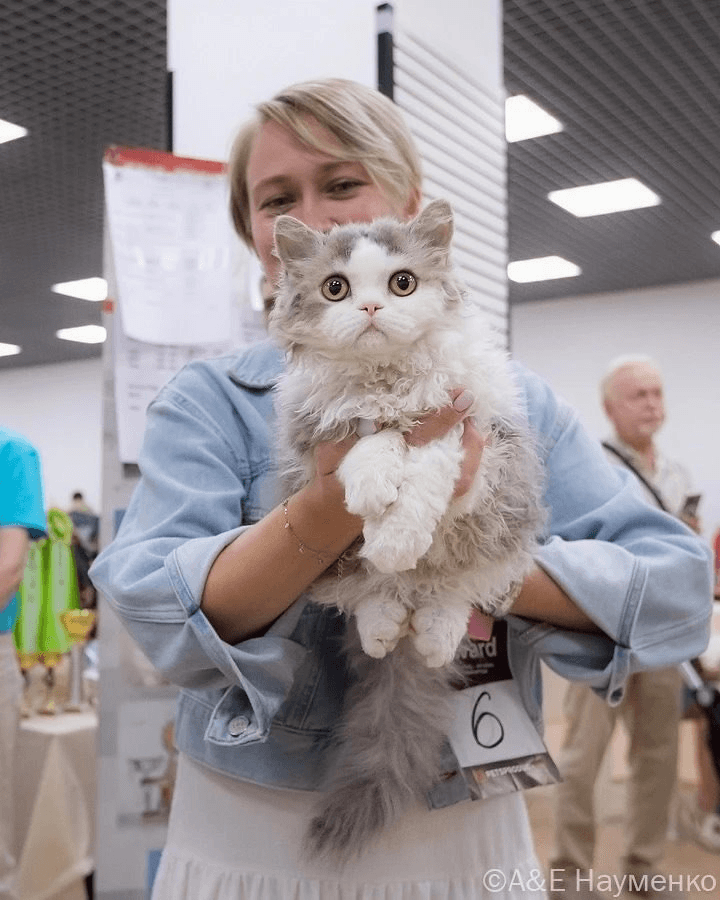
The heterozygote is probably the Selkirk most familiar to the eye. One Selkirk copy produces the coat most people associate with the breed: full and soft, with looser, irregular curls and waves.
Coco Chanel is our example here. Her photograph shows what I consider a very recognisable Selkirk coat: curly, yet still full, without turning into a very fine, uniform wave.

One heterozygote cannot be declared the model for all the rest. Coat is affected by many things: shorthair or longhair, age, season, hormones, ancestry, coat density and the individual cat. Two heterozygous cats can therefore look very different too.
Homozygotes usually prompt the most questions.
Such a Selkirk has two copies of the Selkirk gene variant. This shows that the gene does not work simply as ‘curls or no curls’. One copy and two copies produce different phenotypes.
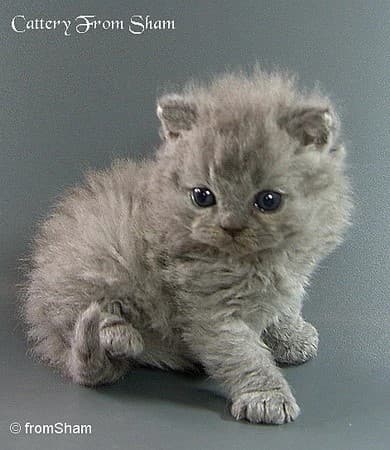
In homozygotes, curls are often denser and tighter. This can be particularly striking in kittenhood. The kitten may also appear lighter in type: the ears look very large, the head less rounded and the body more elongated.
At this point someone sometimes looks at a photograph and asks me, ‘Why does this Selkirk look like that?’
Because it is homozygous.
Gaia is an excellent example. Her kitten photograph clearly shows both the enormous ears and the characteristic, tightly curled coat. Put her beside Coco Chanel and Vesemir, and even without a genetic diagram it becomes obvious why I say that these variants can look so different within one breed.

Homozygotes are especially interesting as kittens. Some undergo a dramatic coat change, including a stage when the kitten loses almost all its coat and then begins to grow it again. A young homozygote should not be judged as though it were a finished adult. The Selkirk coat develops slowly in any case, and in homozygotes that process can sometimes look particularly dramatic.
Another feature of a homozygote matters to the breeder. Because the cat has two Selkirk copies, it must pass one of them to every kitten. There is no ordinary N copy to pass instead.
The genetics of the matings are therefore fairly simple. A heterozygote mated to a Straight will produce, on average, half curly heterozygotes and half Straights. Two heterozygotes have a theoretical distribution of 25 per cent homozygotes, 50 per cent heterozygotes and 25 per cent Straights. A homozygote mated to a Straight produces only curly heterozygous kittens.
The words ‘on average’ are crucial. Genetics does not issue a litter according to a table. A 25 per cent chance of a Straight does not mean that a litter of four must contain exactly one. There may be none, or there may be two or three. The probability applies independently to each kitten.
This is also why I dislike the idea that ‘more curl is always better’.
A homozygote can indeed be spectacularly curly. The Selkirk Rex, however, is more than its coat. The breed has a particular head, bone, body, expression and overall balance. A very strong curl alone does not make one cat better than another.
Nor does a Straight automatically become ‘uninteresting’ because it lacks curls. Sometimes a Straight reveals especially clearly what the full coat of its curly relatives conceals: the structure of the head, proportions, bone and everything beneath that beautiful Selkirk coat.
That is probably why I wanted to explain these terms properly. ‘Straight’, ‘heterozygote’ and ‘homozygote’ sound rather intimidating until you know what lies behind them.
The principle is actually simple.
A Straight has no copy of the Selkirk curly-coat variant. A heterozygote has one. A homozygote has two.
Everything beyond that is the breed itself: all the other genetics, the pedigree, type, coat, lines and the way they come together in one individual animal.
That is why Selkirks can look so different.