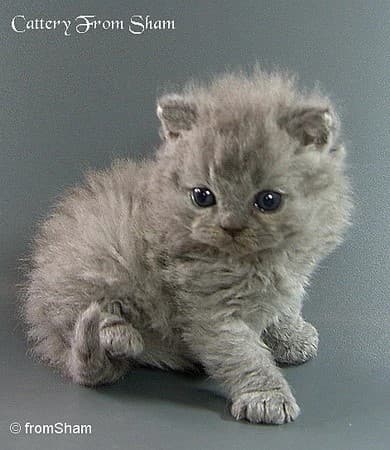
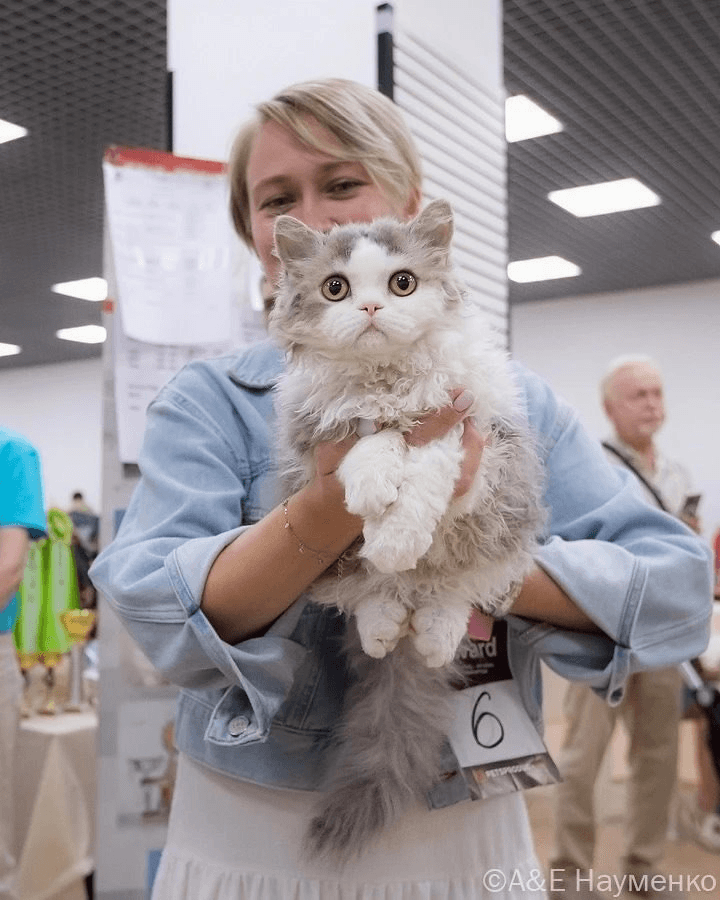
When I recently reconstructed the history of Argo’s Legend, I had to look through an enormous number of old photographs. The first Selkirks, the first litters, animals that have long since gone, their children, grandchildren and great-grandchildren. Beside them on the screen were photographs of the cats with whom I work today. At some point, I realised that more than twenty years separated them. The animals themselves had changed enormously, and my idea of what I wanted to produce had changed with them.
When I began breeding Selkirks, the breed was very young. Outcrosses were permitted, British, Persian and Exotic cats were used, there was far less breeding material, and breeders largely worked with whatever they could find. It was an entirely different task: the breed was still taking shape, and rather than choosing from many established options, you watched to see what would happen when one line was combined with another.
Things are different now. Behind me are almost twenty years of my own litters, relatives, combinations, successful decisions and others I know I do not want to repeat. The question for me ceased long ago to be ‘what will come of this at all?’ and became ‘what precisely from this result do I want to see in the next generation?’ This is probably one of the principal changes in my attitude to breeding work.
At the same time, I have no wish to judge animals of the past through today’s eyes. It would be rather strange to take a photograph of a good cat from 2007 and tell her that she is not modern enough. She was an animal of her time, carried the qualities that were needed then and did her work. But the breed develops, ideas of beauty within the breed change, the available material changes, and one hopes that a breeder’s eye learns something over twenty years too.
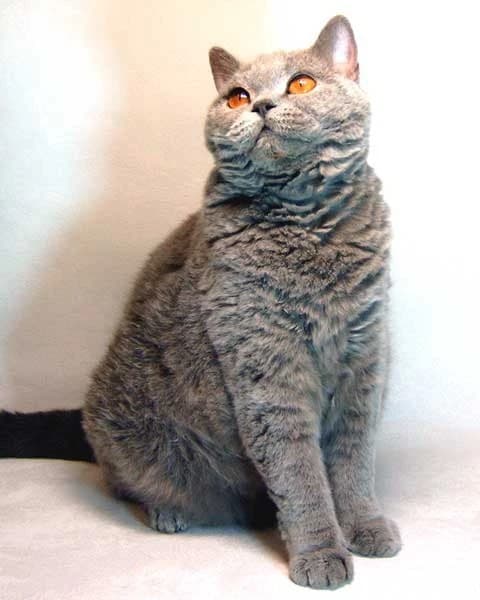
Today I like a round, full head, large round eyes, a short strong muzzle, a good chin, and a solid body and bone. Yet I do not want to turn the Selkirk into a heavy, old-fashioned British cat. British blood has historically played an enormous role in the breed and may still be very useful, but the British phenotype itself is not my aim. I need a Selkirk — simply the Selkirk that I personally consider modern and beautiful.
Perhaps that is why a beautiful pedigree in itself has come to mean less and less to me over the years. ‘An old American line’, ‘rare bloodlines’, ‘Europe’, ‘a famous cattery’: all these things are interesting, sometimes very interesting, especially to someone capable of spending half the night over a pedigree. But a pedigree’s history alone does not make an animal valuable to my programme. What matters far more is what that bloodline actually produces: the head, body and coat, how reliably those traits recur in the offspring, and with which partners the animal works well.
Over time, a pedigree ceases to be a list of beautiful names and becomes a map of decisions. You no longer see only a grandfather and grandmother: you understand why you once used that particular cat, where a particular trait in the next generation came from, and why you want to consolidate it in one combination but avoid strengthening it in another.
The old Argo’s Legend has not disappeared. Sometimes continuity is particularly clear in animals that do not appear to be the most obvious symbols of the breed at all. Taisha, for example, is a straight, without the curls by which most people recognise the Selkirk Rex. Yet behind her maternal line stands a long chain of my own animals reaching almost to the cattery’s earliest generations. Such an animal shows particularly clearly what remains of the Selkirk when the principal decorative effect is mentally removed: the head, eyes, bone, body and the breed’s underlying construction.
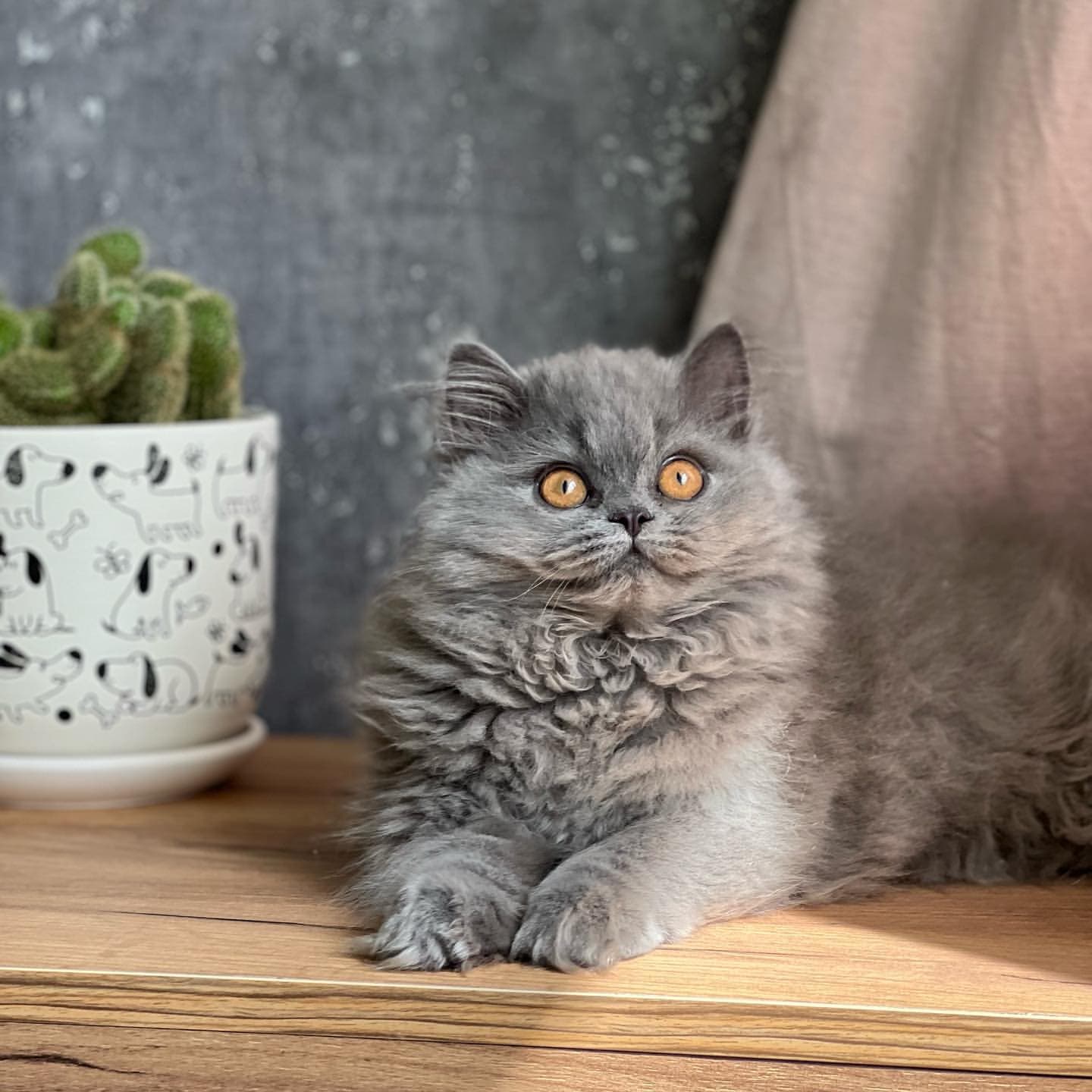
That is why I have never regarded straights as ‘Selkirks that did not work’. Sometimes they are especially interesting to study, because the curls no longer distract the eye from everything else.
Ivetti is another good example of how a breeder’s view changes. When you begin breeding, it is very easy to evaluate breeding cats primarily as individuals: here is a beautiful cat, so she will probably be an excellent producer. In time, however, you discover that an animal’s own glamour and its breeding value are related but by no means identical. A queen may be magnificent herself but transmit her qualities to her kittens rather poorly. Sometimes, on the other hand, you look at several litters by different males and notice a particular group of traits returning persistently, again and again. That is when things become truly interesting.

What I value in Ivetti is precisely this ability to assemble and transmit particular traits: a broad head, large eyes and a short, full muzzle. Her pedigree also combines old Argo’s Legend branches, and she demonstrates especially clearly why it can be important to preserve your own lines. The reason is not to say proudly after twenty years, ‘this is all mine’, but because at some point you begin to understand what you succeeded in accumulating there and how consistently it is passed on.
Then Unicum — From Sham Unicum Curly Charm — entered my breeding programme. Here I must mention Alla Shishkina, because the history of Argo’s Legend would have been completely different without her. It was Alla who bred Zuzi, with whom the Selkirks began for me; many years later, she also had a very significant influence on the cattery’s modern generation.

Unicum’s story, incidentally, still serves as a perfect reminder of how dangerous it is for a breeder to regard herself as clairvoyant. Alla showed him to me when he was tiny, perhaps three weeks old, and said: look what a wonderful kitten. I looked and said no, we would wait for another. I did not seek a different breeder; I already knew I would buy my male from Alla. I simply decided that this particular kitten did not suit me and began waiting for the next.
At around two months, Alla showed Unicum to me again. By then he had already been reserved by other people and was due to leave as a pet. I looked at him once more and said: this cat must come to me. Somehow Alla managed to reach a new agreement with the people who were already waiting for him, and Unicum came to Argo’s Legend.
So a kitten whom I had initially rejected became one of the most important breeding males of an entire stage in my work. It is a very useful story for maintaining healthy humility.
I liked his harmonious broad head, short full muzzle and large eyes, as well as his coat, its texture and very pronounced curl. A substantial part of the cattery’s modern generation descends from Unicum, but, most interestingly, his offspring combined his qualities in very different ways.
Nika, for example, is one of the most successful modern curly Selkirks of my breeding in my view. I see in her much of the type towards which I want to move: a good round head, large eyes, a full muzzle and an overall sense of unity. Then there is Bumblebee, another son of Unicum, with very good coat texture and a strong curl, who is now being considered as a possible male for the next generation.

This invites a very tempting line of reasoning: the son is young, beautiful and curly, so the father has done his work and we can solemnly declare that we have taken a step forward. Breeding work is not that convenient. For example, I still prefer Unicum’s head. Bumblebee has strengths of his own, and characteristics I want to observe, while his offspring are still far too young for final conclusions.
Bumblebee is therefore not ‘Unicum 2.0’ or an automatically improved version of his father. He is already an independent combination of several branches, and he still has to show what he can pass on consistently. Breeding involves an extraordinary amount of waiting: first for a mating, then for kittens, then for the chosen kitten to mature, then for its first offspring, and sometimes for another generation beyond that. Only then can one cautiously say that a trait has genuinely been established rather than simply appearing very successfully once.

Perhaps that is why I have become more cautious over the years with the phrase ‘we improved the line’. One beautiful kitten has not improved anything. It is simply one beautiful kitten. Improvement becomes visible when the desired quality begins to repeat and remains with you in subsequent generations.
Argosha — Argos Allada Cat — marked another important stage. Here, too, I must thank the people without whom I might never have had this cat. His breeder, Inna Mankos, did not want to sell animals for breeding at all and could quite calmly have refused me as well. Alla intervened once again: she strongly supported me and recommended me to Inna as a breeder who could be trusted with a breeding animal. Inna ultimately agreed to sell me Argosha, and I am very grateful to her — and to Alla, for the recommendation and for the trust that had by then lasted many years.

When describing the history of a breeding programme, it is easy to present it as circles moving around a pedigree: a male was bought here, a daughter retained there, and a later litter produced somewhere else. Yet human relationships stand behind many of these decisions. Someone once entrusted you with a valuable animal; someone vouched for you to another breeder; someone accommodated you although they had not originally intended to sell the kitten for breeding at all. Modern Argo’s Legend is therefore the result of more than my decisions alone, and I believe it is right to remember that.
Argosha arrived at a time when I understood much more precisely why I needed a particular breeding male. The dominant blue-eye gene entered the programme with him, but blue eyes alone would clearly have been insufficient for a serious breeding task. I chose him first of all for the type of head I wanted to see in future. Only then did it become interesting to observe how he worked with my different queens.
This leads to another point that becomes increasingly obvious over time: a breeding animal cannot be evaluated separately from its partner. The same male can produce entirely different results with two different queens. I am therefore less and less interested in the question ‘is this a good male in general?’ and increasingly interested in ‘for which of my queens is he a good male, and what particular task should this pair solve?’
I am now gradually reaching a rather amusing point. Many of the traits I once wanted to seek out and strengthen deliberately are already present. Large eyes are present, a full head is present, a short muzzle is present, and good bone is present in several branches too. Suddenly, the next task is not to make all of this even larger, even shorter and even more pronounced.
Sometimes the next step is to stop in time.
Every pronounced breed type has a boundary beyond which further exaggeration ceases to be an improvement. I now think not only about which virtues to combine, but also which characteristics must not be doubled. This is perhaps a very important change in thinking: at first you constantly want to improve something, and later you understand that sometimes it is far harder to preserve what is already good and avoid spoiling it through excessive diligence.
Another task has arisen at the same time. Over many generations, much of the modern core of Argo’s Legend has become related through several key lines. What were once separate branches have gradually joined, and today the true scarcity for me is not another beautiful animal with a new cattery name in the pedigree, but genuinely new genetic material.
‘New’ no longer means merely brought from another country. You may buy a male from the other end of Europe and discover deep in the pedigree the very same lines that are already sitting on the sofa at home. The search is therefore not for a new geography, but for a genuine expansion of possibilities.
Here the story suddenly comes almost full circle. Before Zuzi, I was looking for a British cat. A Selkirk Rex entered my life instead, and everything that followed is already known. Almost twenty years later, I am looking at British cats again.
Only now I know precisely why.
I do not need a British cat for the mere idea of adding one to the pedigree. I am interested in a modern type capable of contributing a stronger, bony head, a good chin, and a solid body and bone without returning the Selkirk to the heavy old British format. The task is simple only in words: take precisely what I came for and politely leave everything else with the British cat.
Perhaps that is why breeding work does not become more boring after so many years. Quite the opposite: at first you mostly delight in a beautiful kitten; then you begin to see individual traits, then families and lines; later you notice that some animals work beautifully together, while others, for all their beauty, should never meet in one pedigree. One day you discover that you are no longer working with individual cats but with an entire system in which any decision made today may echo several generations later.
That is why I cannot choose one cat and say: here she is, the modern Argo’s Legend. Taisha demonstrates historical continuity and the value of the underlying type even without curls; Ivetti shows how important the ability to transmit one’s qualities can be; Nika represents one form of modern curly type; Unicum became the most important breeding male of an entire stage; Bumblebee may prove to be the next step; and Argosha has already opened new combinations that still need to be evaluated.
To me, the modern generation is not a final photograph or a point at which we can say at last: that is it, we have produced the perfect Selkirk and shall now simply copy it. It is, rather, the place the cattery has reached today, with almost twenty years of its own decisions behind it and some understanding of what it still lacks for the next step.
Once, everything was much simpler: I saw Zuzi and fell in love. Now, when I look at a promising kitten, my first thought may still be how beautiful it is, but another question follows almost immediately: what precisely from this animal do I want to see next — and what shall I have to do to achieve it?
That, perhaps, is what breeding work means to me.